
A great conference experience is no longer defined only by what happens on stage.
Attendees now expect more from the events they participate in. They want registration to be seamless, information to be easy to access, networking to feel natural, and communication to be timely.
For event organisers, this means the attendee experience has to be deliberately designed from the moment a guest arrives to the moment the event ends.
The good news is that the right event technology can make this much easier.
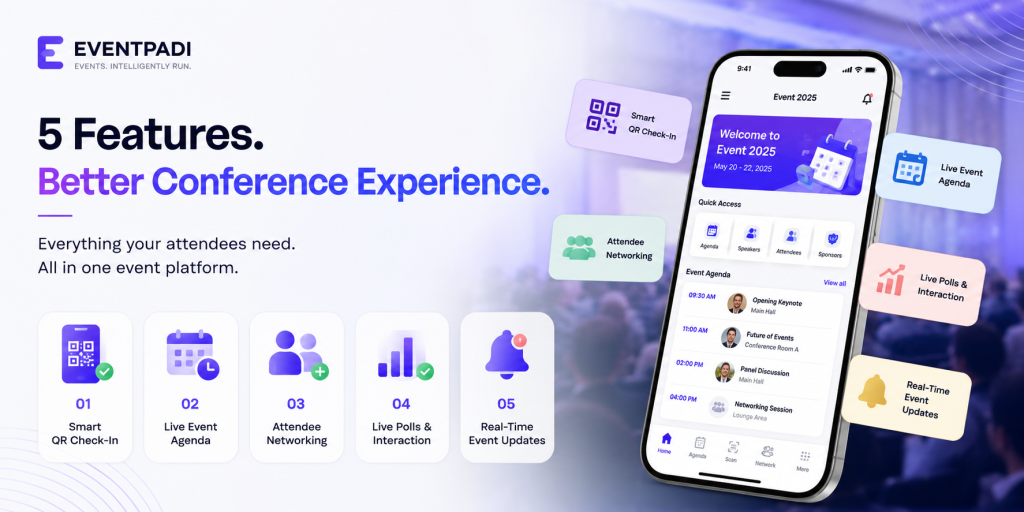
Here are five conference features that can significantly improve how attendees experience your next event.
1. Smart QR Check-In
The attendee experience often begins at the entrance.
Long queues, slow guest verification and manual registration processes can create frustration before the event has even started.
A smart QR check-in system allows attendees to present a unique QR code that can be scanned in seconds.
This can help event teams:
-
Verify attendees quickly
-
Reduce check-in queues
-
Identify different guest categories
-
Manage VIPs and special access
-
Track attendance in real time
-
Support faster badge printing and accreditation
Instead of manually searching through spreadsheets or printed guest lists, accreditation teams can focus on getting attendees into the venue as efficiently as possible.
A smoother entrance immediately sets the tone for the rest of the event.
2. A Live Event Agenda
Conference schedules can change.
Sessions may move to another room. A speaker may arrive late. A workshop might be extended. An important session could be rescheduled.
When attendees are relying on printed programmes or static PDFs, even a small change can quickly create confusion.
A live event agenda gives attendees one place to see what is happening throughout the event.
They can easily access:
-
Session times
-
Speaker information
-
Venue and room details
-
Upcoming sessions
-
Programme changes
-
Important session updates
This allows organisers to keep the programme dynamic while ensuring attendees always have access to the latest information.
Instead of repeatedly asking, “What session is next?” attendees can simply check the event platform.
3. Attendee Networking
For many people, the most valuable part of a conference is not only the content.
It is the people they meet.
Yet putting hundreds or thousands of people in the same venue does not automatically create meaningful networking.
Attendee networking features can help participants discover people they may want to meet based on their interests, industries, roles or organisations.
Depending on the event, attendees can:
-
Browse attendee profiles
-
Discover recommended connections
-
Search by company, role or interest
-
Send connection requests
-
Start conversations
-
Continue relationships after the event
This turns networking from something that happens by chance into something the event actively enables.
For organisers, it also creates another layer of value beyond simply providing sessions and speakers.
4. Live Polls and Audience Interaction
Conferences become more engaging when attendees are able to participate rather than simply listen.
Live polls can allow speakers, moderators and organisers to ask questions and receive responses from the audience instantly.
For example, a speaker could ask:
“What is the biggest challenge your organisation is currently facing?”
Attendees can respond from their phones, and the results can appear in real time.
This can be used for:
-
Live polling
-
Audience voting
-
Quizzes
-
Session feedback
-
Surveys
-
Q&A
-
Audience sentiment
These interactions can make sessions feel more dynamic while also giving organisers valuable data about what attendees are thinking.
Instead of speaking only to an audience, conferences can create opportunities to hear from them too.
5. Real-Time Event Updates
Events are dynamic.
Things change.
A session may move to another room.
Lunch may open earlier than expected.
A networking session may be rescheduled.
An entrance may become unavailable.
The problem is not necessarily that changes happen.
The real problem is when attendees do not know about them.
Real-time event updates allow organisers to communicate important information quickly.
Attendees can receive updates such as:
-
“The next session begins in 10 minutes.”
-
“The panel has moved to Summit Room B.”
-
“Lunch is now available.”
-
“The networking session will begin at 5:30 PM.”
-
“Please use Gate A for venue access.”
This reduces confusion and prevents event teams from repeatedly answering the same questions across the venue.
Clear communication helps attendees feel informed and gives organisers greater control over the event experience.
The Best Conference Technology Should Feel Invisible
Technology should not become another obstacle attendees have to navigate.
The best event technology works quietly in the background.
Attendees simply experience:
Faster check-in.
Clearer information.
Better networking.
More engaging sessions.
Timely communication.
For organisers, the benefit is equally important.
Instead of managing registrations in one tool, guest information in another, agendas somewhere else and attendee communication through multiple channels, event teams can operate from a more connected system.
That means less manual coordination, better visibility and a smoother experience for everyone involved.
Bringing the Conference Experience Together
A successful conference is made up of hundreds of individual touchpoints.
Registration.
Accreditation.
Sessions.
Speakers.
Networking.
Communication.
Engagement.
Feedback.
Each interaction influences how attendees ultimately remember the event.
This is why the future of event technology is not simply about providing more features.
It is about connecting those features into a single, seamless attendee journey.
At Eventpadi, that is what we are building.
From smart QR check-in and live agendas to attendee networking, live polls and real-time event updates, Eventpadi helps event teams create more connected and intelligent conference experiences.
Because great events should not only be easier to organise.
They should also be better to experience.