
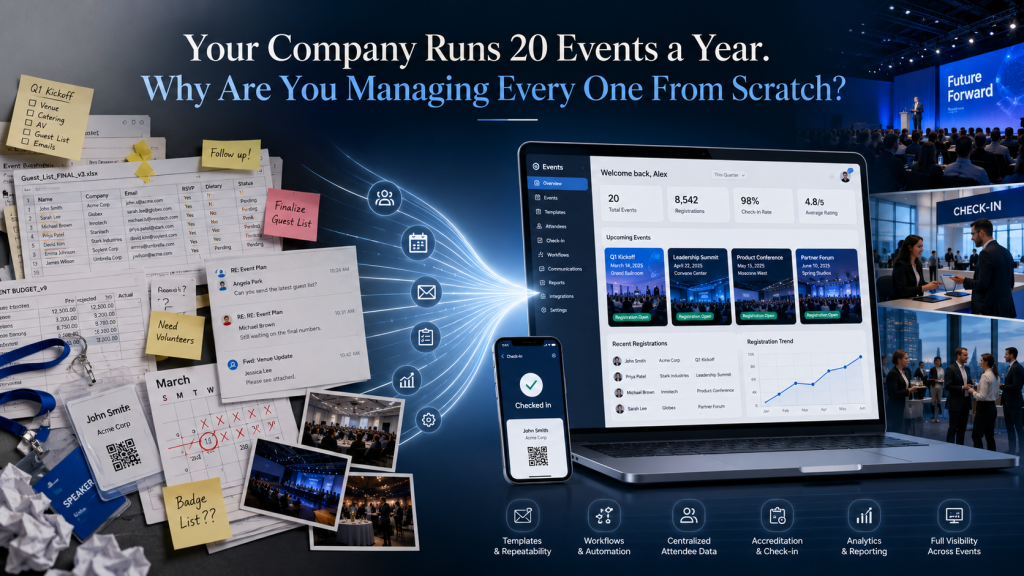
Your Company Runs 20 Events a Year. Why Are You Managing Every One From Scratch?
Many organisations run events all year round: conferences, town halls, customer forums, product launches, trainings, partner meetings, stakeholder engagements and executive sessions.
Yet strangely, each new event often feels like starting again.
A new spreadsheet is created. Someone searches for last year’s guest list. Another person tries to remember which vendor handled accreditation. Registration forms are rebuilt, attendee data is collected from scratch, and teams start passing information around through email threads and WhatsApp groups.
Then the event ends, everyone moves on, and much of what was learned disappears into folders, inboxes and individual laptops.
A few months later, the next event comes around and the cycle begins again.
For an organisation that runs one event every few years, this may not be a major problem. But if your company runs 10, 20, 50 or more events every year, there is a bigger question worth asking:
Why should your twentieth event feel like your first?
Every Event Should Make the Next One Easier
Most parts of a business become more efficient with repetition.
A sales team develops a clear process for managing leads. A finance team establishes workflows for approvals and reporting. Customer service teams build systems that make it easier to handle recurring requests.
Nobody expects these teams to reinvent their processes every time they do their jobs.
Events should be no different.
The first time an organisation runs a major conference, there will naturally be a lot of experimentation. The team is learning what works, how attendees respond, which suppliers are reliable and where operational problems tend to appear.
But that knowledge should not disappear when the event ends.
By the fifth or tenth event, the organisation should already have reusable processes, templates, attendee data, communication structures and established ways of working.
By the twentieth event, the team should be improving an existing system rather than rebuilding the entire operation from scratch.
That is where many organisations fall short.
The Problem Is Not the Event. It Is the Way the Event Is Managed.
Corporate events are rarely simple.
Even a relatively straightforward conference can involve registration, speakers, vendors, attendees, sponsors, payments, agenda management, communications, branding, accreditation, access control, feedback and reporting.
Different teams may be responsible for different parts of the experience, but all of those moving pieces eventually have to come together.
When there is no central system, coordination becomes heavily dependent on people.
Someone has to remember what was agreed.
Someone has to chase updates.
Someone has to reconcile the latest version of the guest list.
Someone has to make sure the registration team has the same information as the communications team.
And when something changes, someone has to make sure everybody else knows.
The event may still be successful, but the amount of manual effort required to make it successful increases every time the operation becomes more complex.
Eventually, a few experienced employees become the unofficial operating system for the organisation’s events.
That becomes risky.
If one of those employees leaves, changes roles or simply forgets an important detail, years of event knowledge can disappear with them.
Your Organisation Should Be Building Institutional Knowledge
Imagine your company has organised 30 events over the last three years.
There is a huge amount of knowledge hidden inside those events.
You may already know which attendees regularly participate, which suppliers consistently deliver, which events attract the strongest turnout, which communication channels drive registrations and which event formats generate the best engagement.
You may also have learned which operational mistakes keep happening.
Perhaps late registrations regularly create accreditation problems. Maybe certain categories of guests require different communication. Perhaps some venues consistently create access-control challenges.
Those insights should become part of the organisation’s knowledge.
But when event information is scattered across spreadsheets, forms, email accounts and personal devices, that knowledge becomes difficult to retain.
The company keeps organising events, but it does not necessarily become better at organising them.
A proper event management system changes that.
It creates continuity between one event and the next.
Instead of treating each event as an isolated activity, the organisation begins to build a body of data, processes and experience that can be reused.
What Reusable Event Infrastructure Actually Looks Like
Suppose your team finishes a conference today and needs to begin planning another one next month.
Instead of creating everything again, much of the foundation is already available.
The registration structure can be adapted rather than rebuilt. Guest categories already exist. Communication templates can be reused. Previous attendee data can help with invitations and segmentation. Accreditation workflows are established, and reporting formats do not need to be recreated every time.
The team can also look back at previous events to understand what worked and what did not.
This changes the nature of event planning.
The conversation moves from:
“How do we organise this?”
to:
“How do we make this edition better than the last one?”
That is an important difference.
The first question is about figuring out the basics.
The second is about improvement.
Your Event Data Should Become More Valuable Over Time.
Every event creates data.
Who registered?
Who attended?
Which sessions attracted the most interest?
Which guests attended multiple events?
Which communications generated the strongest response?
What feedback did attendees give?
Which events performed particularly well?
On its own, the data from one event can be useful.
Across 20 or 50 events, it becomes far more powerful.
An organisation can begin to understand its audience better, improve future programming, identify valuable stakeholders and make better decisions about where to invest its event budget.
Unfortunately, many companies lose this opportunity because every event uses a different registration form, spreadsheet or platform.
When the event ends, the data effectively becomes an archive.
The real value comes when those events are connected.
Your organisation should be able to learn from the cumulative behaviour of its attendees rather than analysing every event in isolation.
Recurring Events Should Become More Efficient, Not More Difficult
There is a simple way to assess the maturity of your organisation’s event operations.
Ask the team:
Are our events getting easier to manage as we run more of them?
If the answer is no, then experience is not being converted into infrastructure.
Your organisation may be accumulating events without accumulating capability.
The goal is not to remove the human element from events. Events will always require judgment, creativity, relationships and good people.
Technology should remove the repetitive work around those people.
It should make information easier to find, processes easier to repeat and responsibilities easier to manage. Leadership should be able to understand what is happening without requesting another spreadsheet, while event teams should spend less time reconciling information and more time improving the attendee experience.
From Individual Events to an Event Operating System
There comes a point where an organisation should stop thinking about events as a series of separate projects.
If events happen regularly across Marketing, HR, Corporate Communications, CSR, Sales, Partnerships or other departments, they become an ongoing organisational activity.
At that point, the company needs more than a registration tool.
It needs infrastructure.
A central place where events can be created, managed and measured. A system that retains what the organisation has learned, allows proven processes to be reused and gives teams better visibility across multiple events.
This is the thinking behind an event operating system.
It is not simply about digitising registration or replacing a spreadsheet.
It is about making the organisation better at running events every time it runs one.
Your Twentieth Event Should Feel Like You Have Done This Before
There will always be something unique about every event.
The audience may change. The venue may change. The programme may change. The objective may be completely different.
But the organisation should not have to relearn how to organise an event every time.
The processes that work should remain.
The data should remain useful.
The lessons should remain accessible.
The team should be able to build on what came before.
Because after running 20 events, you should have more than 20 completed events.
You should have a better way of running the twenty-first.
And if your organisation is still starting from scratch every time, the next question may not be how to plan your next event.
It may be whether your organisation needs a proper event management system.